Home › Free Resources › Learning Center › How to write a construction proposal
Find WorkHow to write a construction proposal
If you are preparing a commercial construction bid, your proposal should make it easy for the buyer to understand exactly what you priced, and what you did not. Here is a practical way to prepare one.
A construction proposal is more than a price
A construction proposal explains what you will build, the price or pricing method, assumptions, exclusions, timing, and conditions of your offer. For commercial work, a clear scope is often more important than an attractive cover page. An estimate may be an internal calculation; a proposal is the document you submit to the buyer. Always follow the invitation-to-bid instructions and required bid forms when provided.
Before you write: check the bid documents
Confirm the correct project name, bid due date, drawing and specification revisions, addenda, alternates, site conditions and who will receive the proposal. Confirm whether the buyer wants a lump sum, unit prices, allowances, separate alternates or a specified bid form. Use the buyer’s required form when applicable; do not substitute your own template for mandatory public-bid paperwork.
The seven sections to include
- Project and company identification: company contacts, project address, proposal date and revision.
- Scope: describe the work you are pricing, organized by trade, location or system.
- Price: identify base price, alternates, allowances, unit prices and tax treatment when relevant.
- Inclusions and exclusions: be explicit about permits, demolition, temporary utilities, equipment, patching, testing and restoration where relevant.
- Schedule: state anticipated duration, start assumptions, lead times and dependencies.
- Qualifications: identify drawing revisions, substitutions, site-access assumptions and offer validity.
- Acceptance: provide a clear contact and the required approval method; do not assume a signature block alone creates an enforceable agreement.
A better scope example
Vague: “Provide electrical work per plans.”
Clearer: “Furnish labor, materials and equipment to install the branch-circuit wiring, boxes and devices shown on drawings E2.1–E2.4 dated [date], including testing and identification. Excludes work not shown, patching by others and after-hours access unless specifically included.”
This is an illustrative example. The project drawings, specifications, contract and actual estimate control the final wording.
Before you hit send
Reconcile the proposal to the estimate and subcontractor quotes. Check quantities, inclusions, exclusions, addenda, arithmetic and schedule assumptions. Name the file so a GC estimator can recognize it, such as Project_Trade_Company_Proposal_Rev1.pdf. Send it through the required bid portal or submission method before the deadline, and save confirmation.
Common mistakes
Avoid burying exclusions in tiny print, offering a price without identifying the drawing set, forgetting alternates, leaving ambiguous unit prices, or implying unapproved work is included. Keep a revision history if pricing changes.
Your next step
Download our free editable Construction Proposal Template and adapt it to your trade and bid requirements. If you regularly manage multiple pursuits, keep an eye out for the Bid & Opportunity Command Center (coming soon) for opportunity and follow-up tracking.
*Important: Project contracts, bid instructions, and required forms control. These educational resources are not legal, engineering, or accounting advice.
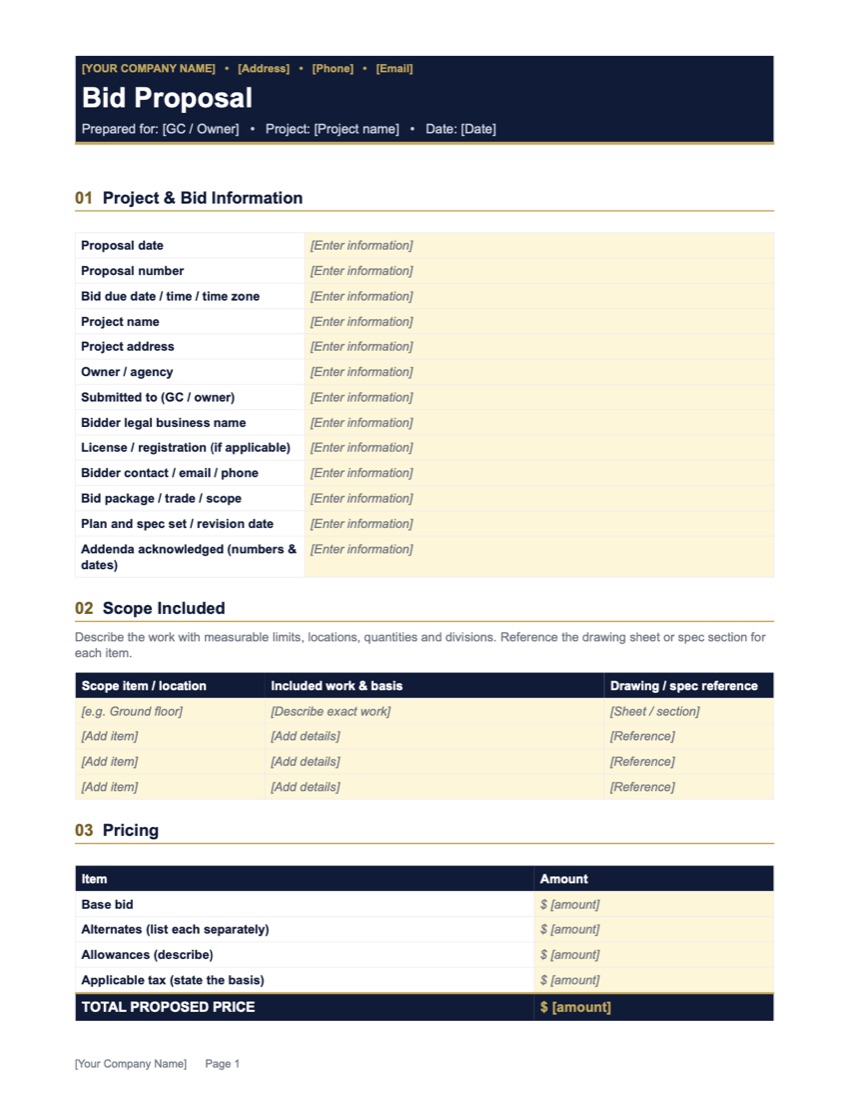
Free Construction Proposal Template
Project info, scope, pricing, exclusions, schedule terms and signatures. Ready to fill in.
Get the free templateBid & Opportunity Command Center
An Excel system for commercial contractors. Score every bid before you estimate it, never miss a requirement on bid day, and follow up until you know the result.
Need a little more help?
Start with a $197 strategy session. If you hire us for a project within 30 days, the $197 comes off the price.